
The Future You versus Artificial Intelligence
 In this article I’d like to cover the issue of how people in our industry can expect to cope with Artificial Intelligence in the not-too-distant future. If your current job involves dealing with figures, research, calculations, assessment, data entry, basic data analysis, telemarketing, presentations or report generation, then you would be well advised to reflect upon how Artificial Intelligence could impact on your future career. According to recent reports from PwC, McKinsey, and the World Economic Forum, AI is advancing at breakneck speed. In fact, AI is developing AI to get better by the hour now! It is expected to fundamentally transform the global workforce by 2050. Estimates suggest that up to 60% of current jobs will require significant adaptation and re-training, due to AI. Although experts typically list AI’s ability to free people from repetitive and mundane tasks as a positive, some believe this particular benefit comes with a downside: a loss or deterioration of people skills. Interaction skills that create the critical trust connection between client and advisor. So this raises a question. How will these AI developments affect client relationships. Can a digital device or devices reasonably expect to do the business without us and build lasting relationships with clients in the process? For smaller ticket items, I would suggest it could. For the bigger ticket items, I would suggest it won’t. The solution, I believe, basically lies in people developing the power of their emotional intelligence (EQ).
An Opinium survey of 2000 Canadians commissioned by MDRT questioned how clients valued emotional intelligence. More than 91% of respondents said it was important for advisors to demonstrate it. The research highlighted the trust that people had in financial advisors with more than 85% of respondents saying that they found qualified financial advisors trustworthy. Great news. Now consider this. With cyber security awareness growing and computer scams and hacking being reported in the press on a regular basis now, I think it is reasonable to assume that trusting technology is becoming a very challenging proposition for many business clients. Despite the high trust ratings from the MDRT survey, there were some relatively simple things that the study identified that advisors could do immediately to improve their trustworthiness:
- 58% said communicate in a way that’s easy to understand. (This is a big challenge for many in our industry from my experience)
- 53% said follow through on promises.
- 48% said deliver authentic and personalised communication (Clients want to feel heard and understood by their advisors.)
Despite the rising role of technology, insurance is a people’s business. Outside legal obligations, its generally not bought, it has to be sold. Most insurance products exist solely because of emotion – fear of risk, exposure and liability. Humans are emotionally driven and as insurance offers products that help deal with life’s challenges and adverse events, emotional connection reduces the impact of those occurrences. While we’re in the midst of a technological revolution in the industry, emotional intelligence can be a leading driver for innovation.
What is Trust?
Trust is built by telling the truth over time and as well as on authenticity and transparency. If you possess high emotional intelligence you will be able to express yourself authentically, build rapport with others, and establish genuine connections based on mutual respect. By being authentic and true to yourself, you can earn the trust of your colleagues, clients, or customers.
By understanding and applying these psychological principles of trust-building and developing emotional intelligence, you can cultivate strong, meaningful long-term relationships. There is no doubt that AI will advance your ability to quickly produce financial assessments and recommendations while impressively and effortlessly managing same but it is unlikely to create the basis of life-long, relationships as a consequence. Building trust is a gradual process that requires effort, consideration, thoughtfulness, consistency, and genuine intention, all factors that represent great emotional intelligence and factors that AI will find increasingly challenging to replicate.
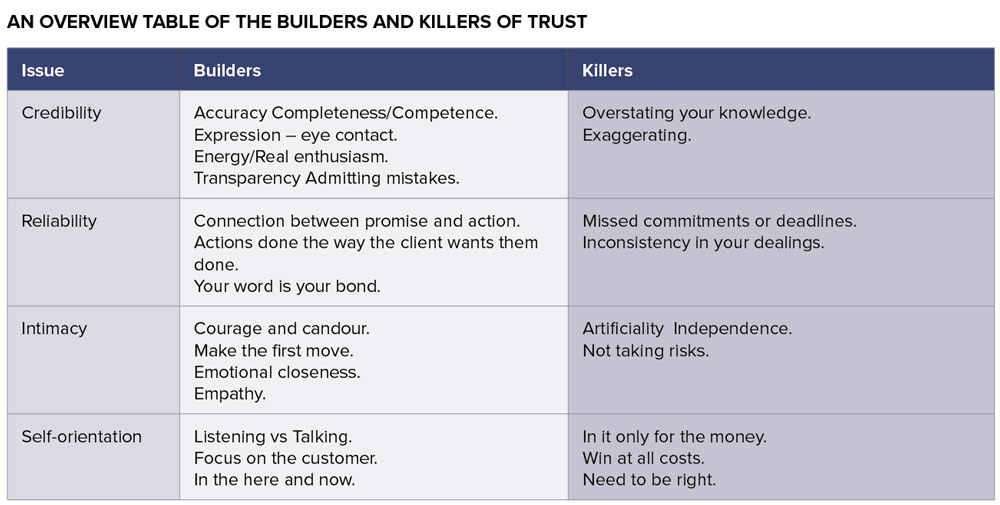
Here’s a list of factors that could demonstrate trustworthiness and emotional intelligence to a prospect or client.
- Improving your interpersonal skills before, during and after interactions (Active listening being a major one at all three stages)
- Providing a dedicated key account manager to the client (ownership)
- Your experience in the market (You’ve learnt from other’s mistakes)
- Your experience of their industry or business (e.g. you deal with targeted groups like farmers, self-employed, commercial clients etc)
- Your annual review process (continuously conducting it every year regardless of prospect of any new business being secured)
- Your communication – making it simple and easy to understand (jargon free)
- Your current client list or testimonials from happy clients (proof of quality)
- Your access to certain specialised products, services or experts
- Your availability e.g. 24/7/365 – providing your mobile number if they need you in an emergency
- Your offer to present to others if required e.g. to their Board of Directors?
- Your marketing – ezines, blogs, podcasts, social media, press coverage
- Comprehensively covering the four major purchasing, influencing factors with clients i.e. time, money, quality and quantity
- Providing proof in presentations e.g. independent surveys backing up your claims
- Your follow-through i.e. your word being your bond
- You’re an owner of it yourself
- Your brand and track record to date
- Outlining awards you or staff may have won (Proving you are winners = no risk)
- Offering gratitude for the business or opportunity, even if not successful
Expanding on this list will surely develop trustworthiness.


